
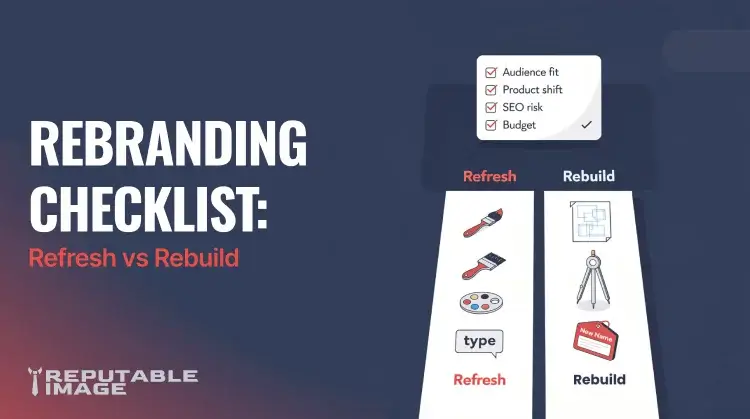
Use this rebranding checklist to determine whether your business needs a visual refresh or a full rebuild of brand strategy. A refresh updates visuals, messaging, and small structural pieces; a rebrand re-imagines positioning, name, promise, and often the business model beneath the brand. This article walks you through the signals to watch for, the practical checks to run, and a phased plan to execute the right move with minimal disruption.
A brand refresh modernizes colors, typography, photography, and messaging while keeping the core brand architecture intact; it’s about staying relevant without breaking recognition. A rebrand is a strategic reinvention—new positioning, possibly a new name, updated target audience, and a redesigned brand system that supports a new strategy. These distinctions are widely used in industry guides and marketing playbooks. (HubSpot)
Choose a refresh when your visual identity feels dated, your brand voice is inconsistent, or you need to support a product tweak or seasonal repositioning. Other reasons include minor audience shifts, a competitor refresh that makes you look old, or changes in leadership who want a modern look without changing your promise. A refresh is lower risk and usually faster and less expensive than a full rebrand. (Forbes)
Consider a rebrand when your core audience, mission, or category has changed—if you pivot markets, merge with or acquire another company, or face deep reputation issues that visuals alone can’t fix. A rebrand is also appropriate when your current brand meaning actively blocks growth (for instance, an outdated name or category mismatch). The cost and disruption are higher, but rebrands can unlock new markets and reset perceptions when done for strategic reasons. (CIM)
Before you act, run this quick internal audit: (1) customer perception, (2) competitive position, (3) business strategy alignment, (4) visual system health, (5) technical debt (CMS, platform, product naming), and (6) stakeholder appetite and budget. If core elements (1–3) are misaligned, you’re more likely headed for a rebrand. If only visuals and messaging are inconsistent, start with a refresh. This checklist guides the conversation across leadership, product, and marketing teams.
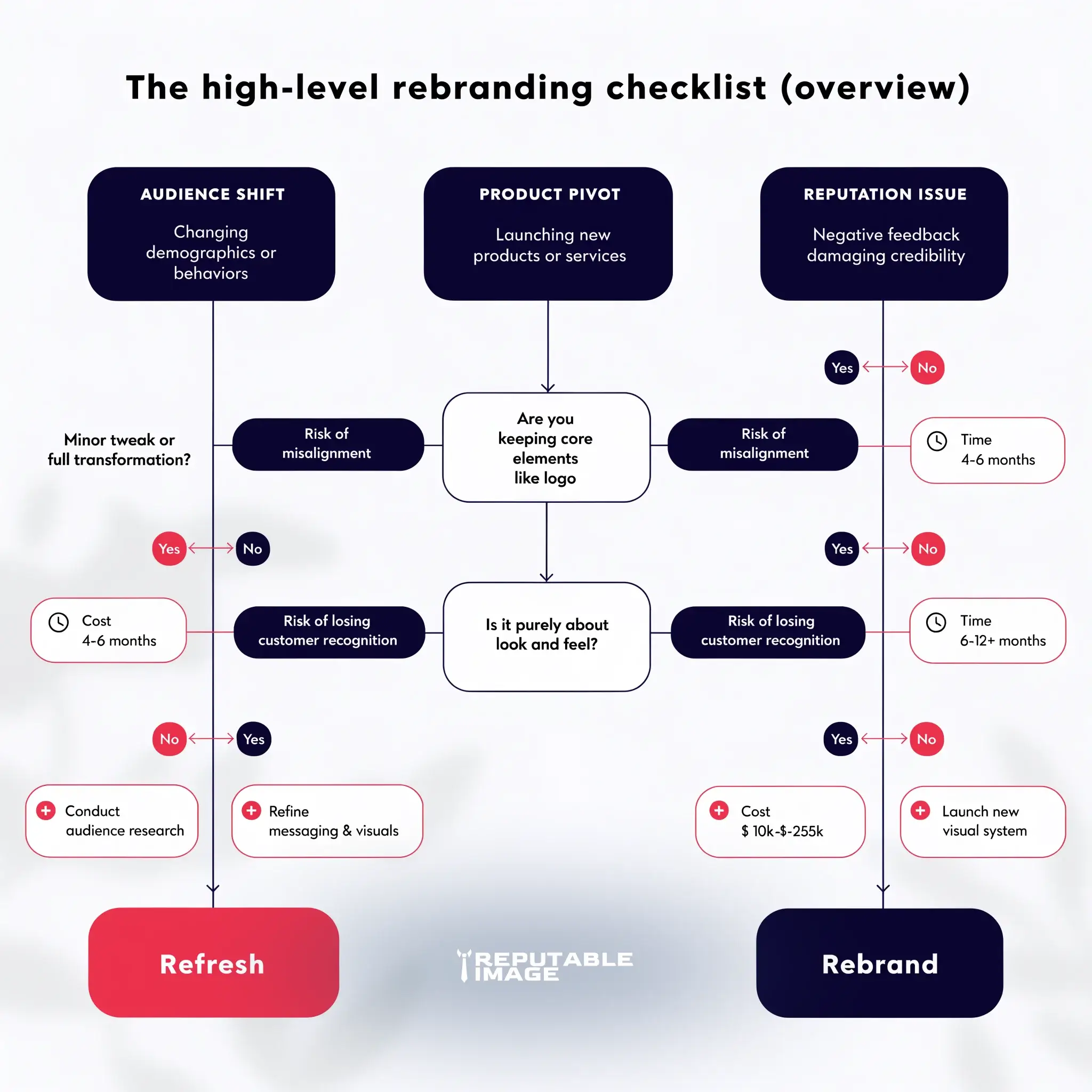
Run qualitative interviews and quantitative analytics: Net Promoter Score trends, sentiment on social, and conversion performance for key pages. Map customer journeys and look for consistent friction points tied to perception or messaging rather than product UX. If research shows the product fits but perception lags, the change required may be cosmetic; if product fit is poor, strategy must be addressed.
Measure what customers actually remember: name recall, logo recognition, and brand associations. Survey existing users and run a quick brand task analysis—can people describe what you do with one sentence? High recognition with fading modernity points to refresh; low recognition and outdated associations often push toward rebranding. Use sample size appropriate to your business scale and segment results by buyer persona. For practical logo and lockup guidance when you refresh visuals, see How to Design a Logo That Scales.
Audit all touchpoints: website pages, product names, packaging, legal assets, social channels, ads, sales decks, and partner collateral. Map dependencies (APIs, translated content, integrated platforms). If you have widespread naming or platform entanglement, a rebrand will need a larger technical rollout budget; a refresh can often be deployed iteratively.
Get executive alignment on goals, timeline, and acceptable risk. Build a simple risk matrix: customer confusion, SEO impact, legal conflicts, cost/time, and team bandwidth. If the answer to “are we willing to migrate name/URLs/legal entities?” is yes, a rebrand is feasible; if not, plan for a refresh with stricter constraints.
A rebrand often requires URL changes, redirects, and careful preservation of search equity. Plan 301 redirects, update Google Search Console, and prepare PR to explain the change; lack of careful planning is a common rebrand failure mode. If you keep the same domain and only change visuals, the SEO impact is minimal—another reason many businesses choose refresh when possible. (Use dev and SEO teams to model traffic risk.)
Always pilot brand changes where possible: test new messaging in ads, run landing page experiments with refreshed visuals, and trial a new logo in email footers or social channels. Use A/B testing to measure conversion impact and conduct controlled soft launches. For full rebrands, adopt a phased approach (internal launch → partner launch → public launch) to catch issues before broad exposure. To measure pilot performance and UX impact post-rollout, see Using Analytics to Improve UX.
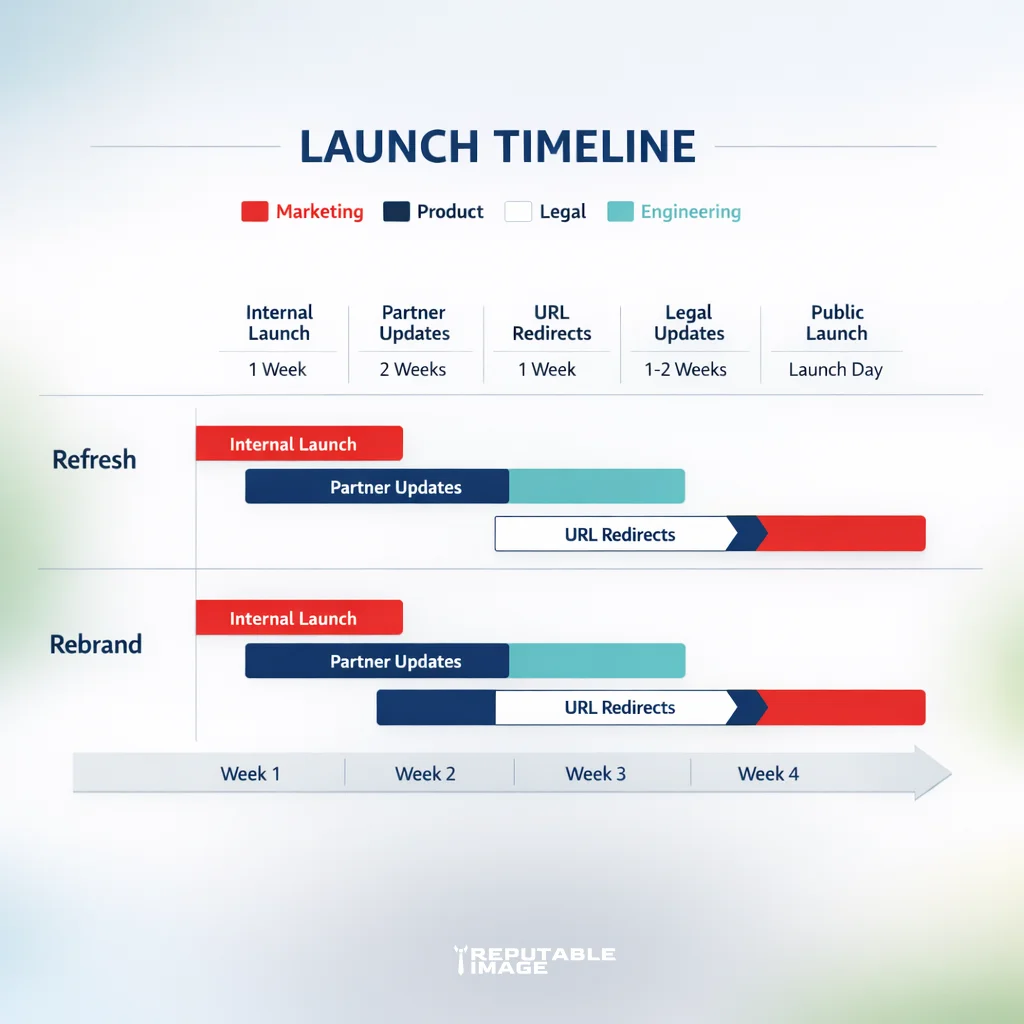
Refresh projects can be budgeted as marketing initiatives (weeks to 3 months, modest design/asset costs). Rebrands are multi-discipline projects often requiring 6–12+ months with legal, product, and engineering costs included. Always pad timelines for stakeholder review and technical migration; rushed rebrands are where details break.
Don’t rebrand purely to chase trends—brand changes must solve a business problem. Avoid cosmetic-only refreshes when the market is signaling strategic misalignment, and avoid full rebrands when a quick brand modernizing would have sufficed. Keep customers informed and preserve usability: broken redirects, old logos in active channels, or mismatched messaging confuse buyers.
A refresh is low-risk, fast, and ideal when your fundamentals are sound but aesthetics or voice need modernization; a rebrand is strategic, costly, and necessary when your market, business model, or core promise has changed. Use this rebranding checklist to run a rapid audit, get stakeholder alignment, and choose the option that minimizes customer disruption while maximizing future growth.
Mobile-first design is discipline: prioritize core actions, optimize for speed and touch, and test thoroughly on real devices. Small teams that bake performance and testing into their process ship faster and deliver happier mobile users.
Need help executing a phased rollout? We can run the rebranding checklist with your team, build the visual system, and handle URL migrations and launch communications so you don’t lose momentum.
Sources:
1. Tristen Taylor at HubSpot - "Brand Refresh vs Rebrand: Which is Best for You?"
https://blog.hubspot.com/marketing/rebrand-successfully
2. Dave Wedland at Forbes - "Five Reasons For A Brand Refresh"
https://www.forbes.com/councils/forbesagencycouncil/2021/08/06/five-reasons-for-a-brand-refresh
3. Laura Bracher at CIM - "Brand refresh vs. full rebrand: Knowing when to pivot"
https://www.cim.co.uk/content-insights/articles/brand-refresh-vs-full-rebrand-knowing-when-to-pivot
