
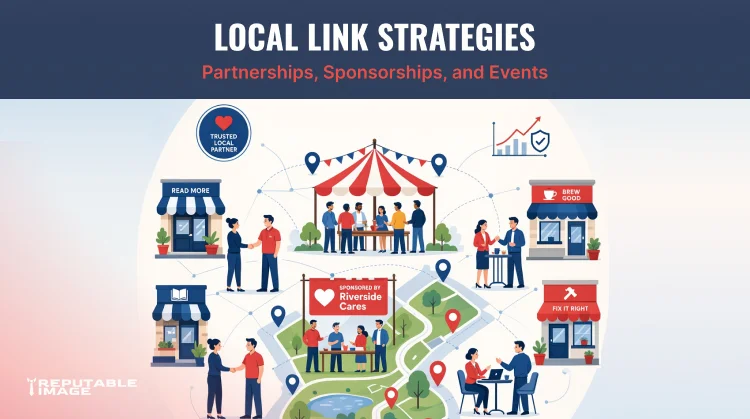
Building high-quality backlinks doesn’t always require expensive outreach campaigns, national media coverage, or aggressive link swaps. Many of the strongest opportunities are hiding in plain sight—within your own community. By forging genuine relationships with local businesses, nonprofit organizations, and community event organizers, small and medium-sized businesses can earn authoritative, topically relevant backlinks that fuel long-term SEO success. These connections not only improve online visibility but also deepen your presence in the local market, leading to a virtuous cycle of brand recognition, trust, and customer loyalty.
A successful local link-building strategy focuses on earning backlinks that reflect genuine community involvement. Authentic partnerships, smart sponsorships, and active participation in community events all contribute to a stronger search authority while supporting organic business growth.
Search engines evaluate backlinks as endorsements of trust and authority. When a website links to yours, it signals that your content or business is worth referencing. But not all links carry equal weight. A backlink from a nearby chamber of commerce, a well-known local nonprofit, or a complementary small business in your neighborhood carries a layer of geographic and topical relevance that generic links often lack. These localized signals help search engines understand precisely where your business operates and who it serves, increasing the likelihood that your site appears for “near me” searches and other local queries. To improve your overall local search presence, read Local SEO for Multi-Location Businesses.
Beyond algorithms, local backlinks often drive highly qualified referral traffic. Someone browsing a community foundation’s website, a local event calendar, or a regional business association directory already has a geographic connection to your service area. That visitor is much warmer than a random click from a generic blog post. They share your community, which makes them far more likely to become a customer, client, or patient.
Local backlinks also reinforce your offline brand authority in the digital space. They’re not merely SEO levers; they’re proof of your business’s active role in the local ecosystem. This dual impact—ranking improvements plus meaningful referral traffic—makes local link building one of the highest-ROI activities a business can pursue.
Partnering with complementary local businesses creates a fertile ground for authentic backlinks. The key word is complementary: think a wedding photographer teaming up with a florist, a real estate agent collaborating with a mortgage broker, or a fitness studio partnering with a nearby smoothie cafe. These pairings aren’t competitive; they serve overlapping customer bases and naturally enhance each other’s offerings.
Joint initiatives—such as co-hosted workshops, educational webinars, neighborhood clean-up events, or co-branded resource guides—often result in both organizations linking to one another from their respective websites. A “Recommended Partners” or “Community Resources” page can be mutually beneficial, but the gold standard is a dedicated blog post, event recap, or resource hub that naturally weaves in the partner’s link contentually.
The most successful partnerships transcend simple link exchanges. They focus on bringing tangible value to the local community. For example, a real estate agency and a home inspector might collaborate on a “First-Time Homebuyer’s Checklist” that both promote. The agency embeds the checklist on their website and links to the inspector’s credentials page, while the inspector links back to the agency’s guide. Both provide useful information, and both earn backlinks in a way that feels editorially natural rather than transactional. Search engines reward this type of contextual, relevant linking far more than they do superficial reciprocal links.
Over time, these relationships often evolve into robust referral networks. The connections you build for backlinks can also become a steady source of warm leads, cross-promotional social media shout-outs, and collaborative advertising opportunities. That’s the secret of local link building at its best: it strengthens your real-world business, not just your search rankings.
Sponsoring community organizations, youth sports teams, nonprofit events, educational programs, or local charities is a time-tested way to build goodwill—and it almost always comes with a digital footprint. Most organizations publicly acknowledge their supporters on a dedicated sponsorship page, complete with business name, logo, and a link to the sponsor’s website. These pages are typically hosted on well-established, trusted domains—such as .org, .edu, or local government sites—that carry substantial authority in the eyes of search engines.
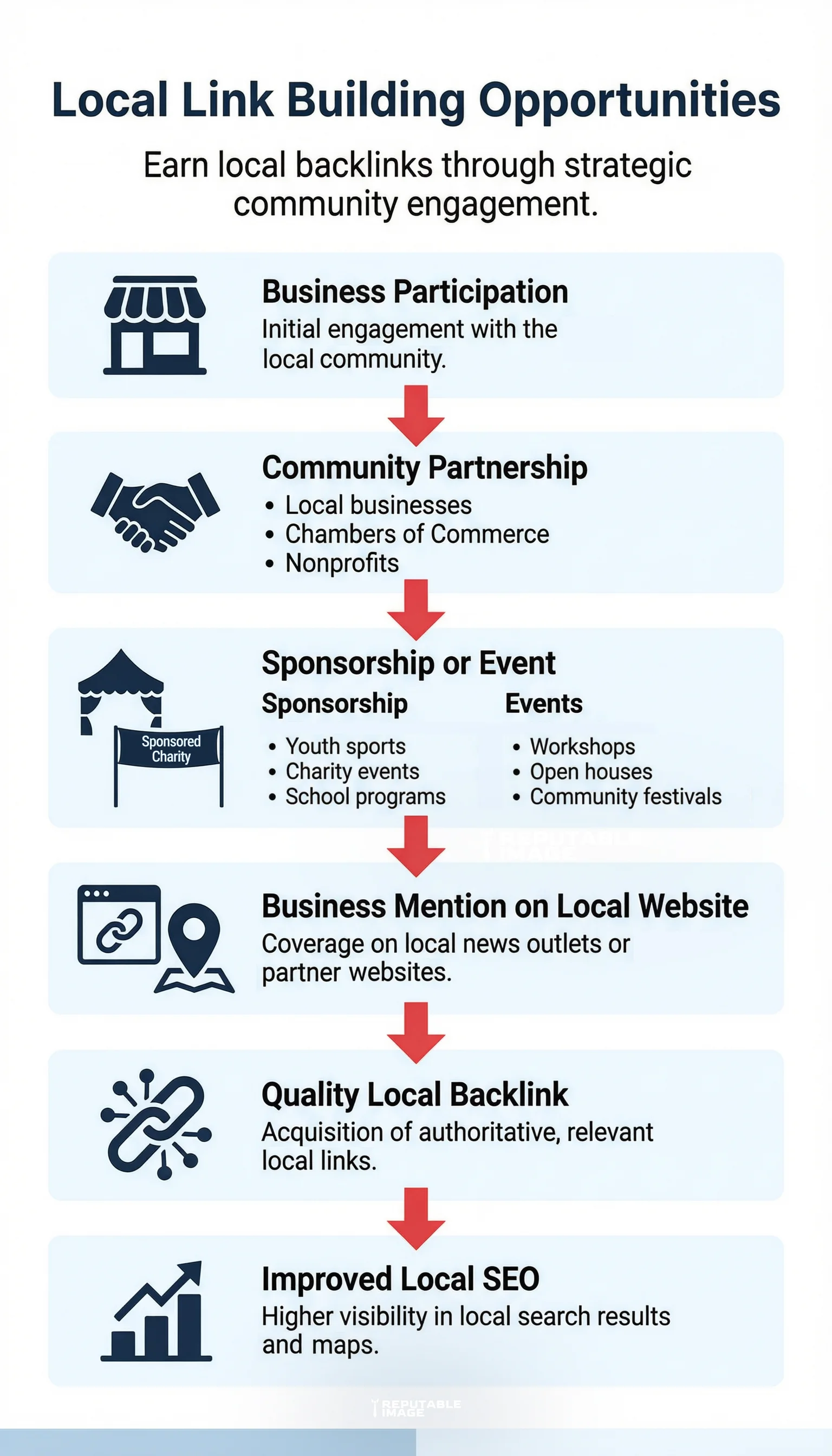
For example, sponsoring a Little League team can yield a link from the league’s official website. Supporting a scholarship fund at a local community college might earn a mention on the school’s .edu domain. Funding a booth at a charity 5K often leads to a listing on the event’s promotional page. Each of these backlinks is topically relevant (they exist within your geographic area) and contextually surrounded by information about your community—exactly the type of signals search engines love.
But the benefits extend beyond SEO. Sponsorship demonstrates that your business is invested in the community’s well-being, which strengthens brand recognition and consumer trust. Surveys consistently show that customers prefer to buy from businesses that support local causes. The visibility generated from event signage, program booklets, and social media mentions amplifies the impact far beyond the initial backlink. By selecting sponsorship opportunities that align with your brand values, you create a cohesive narrative that resonates with both customers and search algorithms.
To maximize the SEO value, ensure that the sponsoring organization links to your website using a clean, descriptive anchor text—ideally your business name or a simple branded URL. Avoid over-optimizing with keyword-stuffed anchors, which can look manipulative. A natural link is more sustainable and safer in the long run.
Hosting or participating in local events creates a constellation of backlink opportunities. Event listings, community calendars, chamber of commerce websites, local news outlets, and partner organizations frequently publish event information that links back to the participating businesses. A single well-planned event can generate mentions on half a dozen trusted, locally relevant domains.
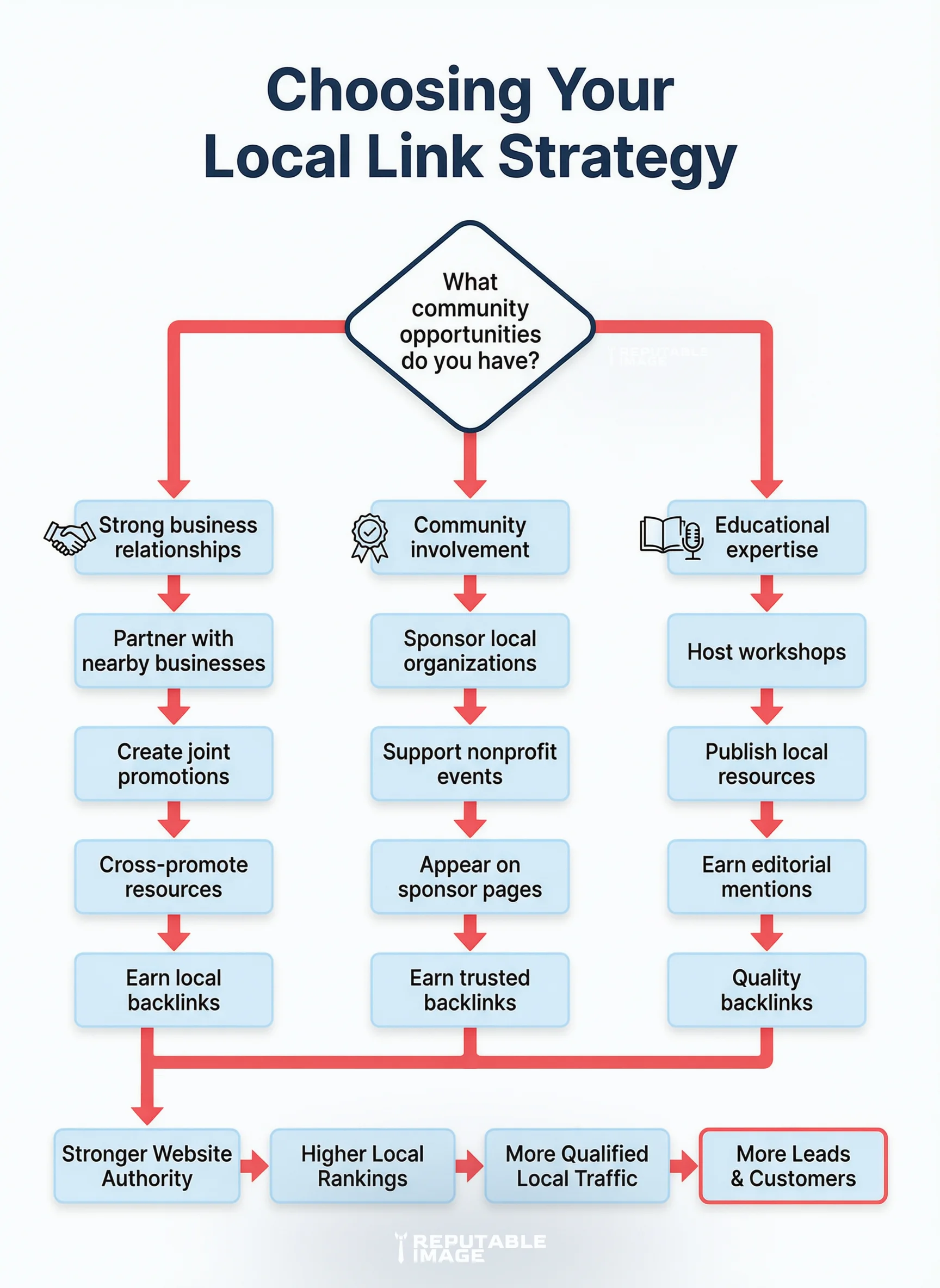
Imagine a family-owned hardware store hosting a “DIY Garden Planter Workshop.” The event might appear on:
Each of these instances adds a new, contextually appropriate backlink. The variety of sources signals to search engines that your business is naturally embedded in the local fabric, not artificially constructing links for ranking purposes.
Beyond backlinks, events generate social media buzz, word-of-mouth marketing, and often local press coverage. Local reporters are always looking for feel-good community stories, and a well-executed event can result in an article on a news site—another high-authority backlink. To increase the chance of coverage, draft a simple press release or media advisory and send it to local reporters ahead of time. Include compelling photos after the event and offer a short, engaging quote they can use.
Each touchpoint also creates additional networking opportunities. When you collaborate with multiple vendors or organizations, you expand your circle of potential link partners for future initiatives. Over time, this web of connections becomes a self-sustaining link building engine that requires less active outreach.
While partnerships, sponsorships, and events are relationship-based strategies, businesses can also attract backlinks passively by creating content that local organizations find inherently useful. These resources become “link magnets”—pages so valuable that other websites choose to reference them without being asked. To create content that naturally attracts backlinks, read Content Repurposing on Social Media, Email, PDF.
Consider the types of resources that thrive locally:
The common thread is that these resources serve a specific, underserved local need. They’re not brochure pages singing your own praises; they’re genuinely helpful tools for your community. When done right, they continue attracting backlinks months and years after publication—often without any ongoing effort from you.
Promote these resources to your existing local partners first. If you’ve already built relationships with a chamber of commerce or a nearby complementary business, a quick email letting them know about a new guide is far more effective than cold outreach. Because you’ve established trust, they’re more inclined to share and link to your content.
Local link building is a long-term strategy, and its success should be measured holistically—not just by the number of backlinks acquired. A handful of highly relevant, authoritative local links can outweigh dozens of generic ones. Track these metrics to get a full picture of impact:
Patience is essential. The compounding effect of local link building means results often accelerate over time. A relationship established today might yield a link next month, a guest post opportunity next year, and a co-hosted event the year after. Avoid the temptation to abandon the strategy after a few months; commit to consistent community engagement and content creation, and the backlinks will accumulate.
Local partnerships, sponsorships, and community events offer a sustainable, high-impact pathway to earning authoritative backlinks without a massive budget. By focusing on genuine community involvement instead of manipulative shortcuts, businesses improve not only their search engine authority but also their real-world reputation and referral networks. The backlinks you earn through a Little League sponsorship, a chamber of commerce partnership, or an annual charity gala are precisely the kind of trust signals that search engines and customers alike appreciate.
At Reputable Image, we help businesses craft local SEO strategies that blend relationship building, technical optimization, and content marketing into a cohesive plan for long-term success. If you’re ready to strengthen your local visibility, earn more valuable backlinks, and become a recognized pillar of your community, click below to Call for SEO help and get started.
Sources:
1. Google Search Central - "Link Spam"
https://developers.google.com/search/docs/essentials/spam-policies#link-spam
2. Moz - "Beginner's Guide to Link Building"
https://moz.com/beginners-guide-to-link-building
