
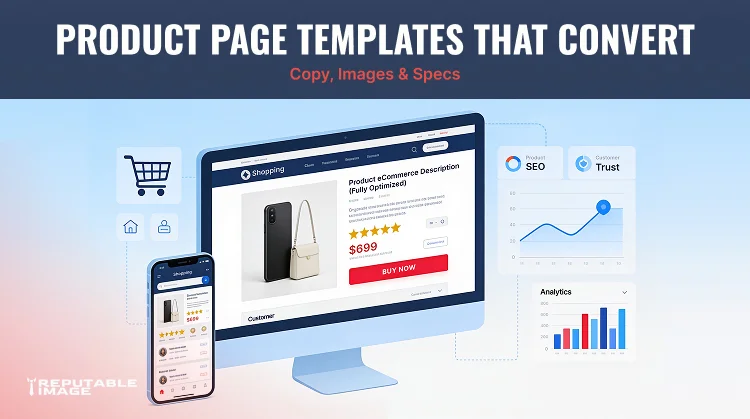
A product page has one primary goal: helping visitors feel confident enough to make a purchase. While attractive design certainly catches the eye, the most successful product pages combine persuasive copy, high-quality images, detailed specifications, and intuitive layouts to answer every customer question before it becomes an objection. When a shopper lands on your page, they are looking for reassurance—that the product will solve their problem, that it’s worth the price, and that your business is reliable. Every element on the page contributes to that final “add to cart” click. Businesses that invest in complete, informative product pages see higher conversion rates, lower return rates, and better search visibility. In this guide, we’ll break down the essential ingredients of a converting product page and how to implement them using proven templates and strategies.
Product pages are often the first─and sometimes only─interaction a potential customer has with your products. A visitor may arrive directly from a search engine results page, a social media ad, or an email campaign. Regardless of the entry point, the product page must immediately communicate value, build trust, and nudge the shopper toward action. A poorly constructed page with thin content, one blurry image, and no clear call-to-action abandons that visitor to uncertainty─and uncertainty almost always leads to a bounced session.
Beyond conversions, well-optimized product pages play a major role in search engine optimization. Search engines reward pages that provide detailed, unique, and relevant content. A robust product page that includes original descriptions, technical specifications, and user-generated content like reviews has far more ranking potential than a page with a few lines of manufacturer boilerplate. Moreover, rich product pages can earn enhanced search appearances─such as star ratings, price, and availability─through structured data, which increases click-through rates and drives highly qualified traffic.
Think of each product page as a dedicated salesperson working 24/7. It needs to answer questions, overcome objections, and close the deal with the same skill and empathy as your best in-store associate. By treating product pages as living assets that can be tested, refined, and improved, you create a scalable engine for revenue growth.
The words on your product page are your silent sales pitch. Effective product copy goes beyond listing features; it translates those features into tangible benefits that resonate with the customer’s needs and desires. A feature might be “10,000 mAh battery,” but the benefit is “power through a full day of travel without hunting for an outlet.” This benefit-first approach helps shoppers visualize how the product fits into their lives.
Start with a compelling headline that includes the product name and a primary benefit or keyword. Follow with a brief, emotionally engaging opening paragraph that summarizes what makes the product special. Then, use the body of the description to address common pain points and explain how the product solves them. Keep language conversational and accessible; avoid jargon unless your audience expects it.
Formatting is critical for readability. Break text into short paragraphs of two to three sentences. Use bulleted lists to highlight key features and benefits, making it effortless for scanners to absorb information. A typical template might include:
Remember that the goal is to preemptively answer questions. If your customer is likely wondering about battery life, durability, or compatibility, address it directly and clearly. Avoid hyperbole, overpromising leads to returns and disappointed customers. Instead, build credibility through specific, honest expectations.
Finally, include a clear, action-oriented call-to-action (CTA). Whether it’s “Add to Cart,” “Buy Now,” or “Customize Your Order,” the CTA should stand out visually and use language that removes hesitation. For higher-consideration purchases, softer CTAs like “Start Your Design” or “Request a Quote” can ease the commitment.
Product photography is often the hinge on which a purchase decision swings. When shoppers can’t physically touch or examine a product, images must bridge the sensory gap. High-quality, professional photos build trust, reduce uncertainty, and dramatically lower return rates.
Best practices for product images include:
User-generated content, such as customer photos or unboxing videos, adds another layer of authenticity. Many successful e-commerce brands integrate a social feed or a gallery of customer-submitted images directly on the product page. This social proof shows real people using and enjoying the product, which can be more convincing than polished studio shots.
Remember to optimize images for web performance─compress files, use next-gen formats, and implement responsive sizing so that high-quality visuals don’t slow down page load times. A stunning but slow-loading image is self-defeating.
Specifications answer the practical, no-nonsense questions that stand between a shopper and a purchase. While marketing copy appeals to emotion, specs appeal to logic. A customer comparing similar models needs to know exact dimensions, weight, material composition, compatibility, and technical requirements. The absence of this information introduces doubt; the presence of it, presented clearly, removes friction.
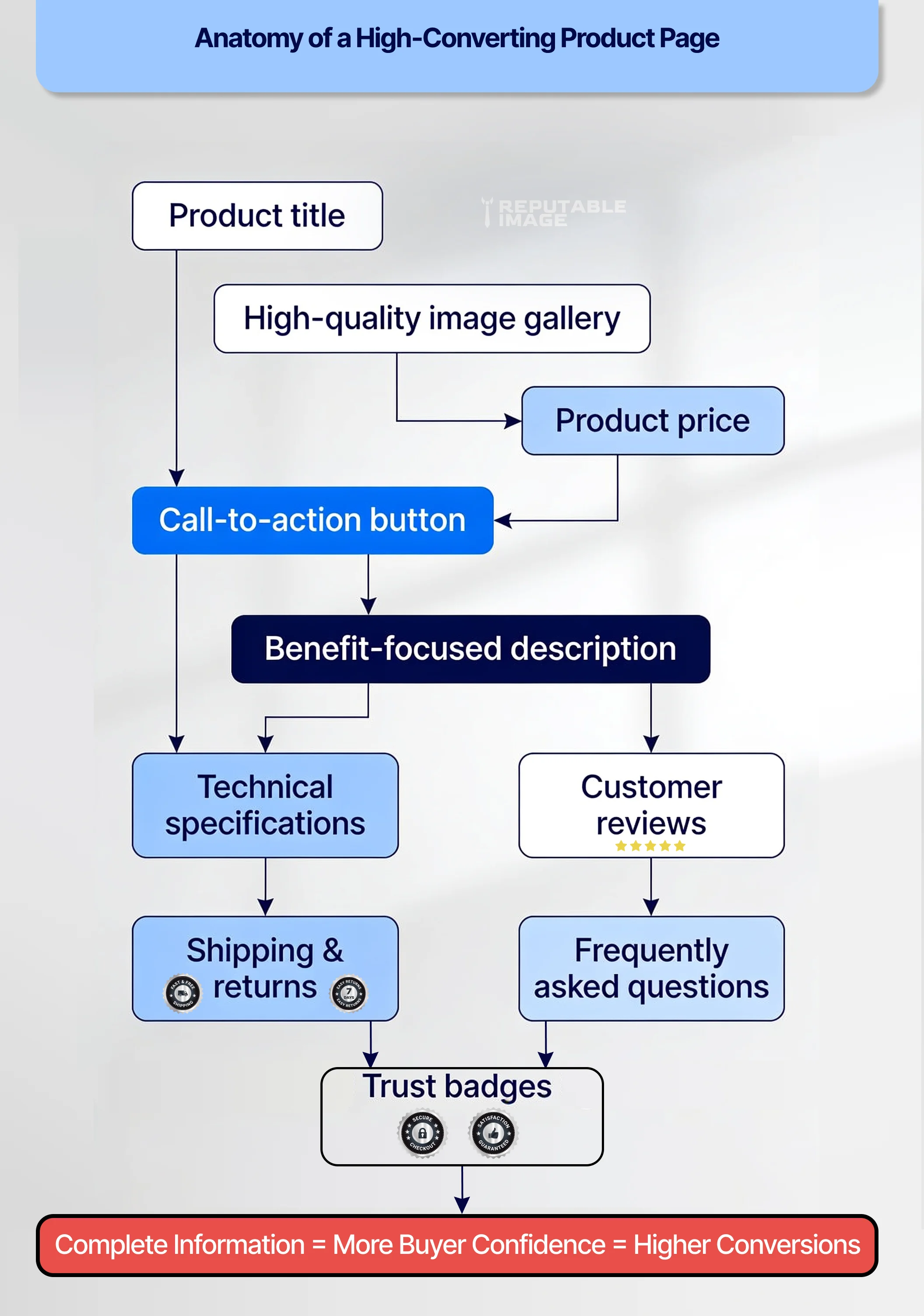
Present specifications in an organized, scannable format. A comparison table works well if you have multiple variants. Use clearly labeled sections such as “Dimensions & Weight,” “Materials & Care,” “Technical Specs,” and “What’s Included.” For clothing and footwear, size charts with measurement instructions are essential. For electronics, list ports, battery life, processor, and included accessories.
Clarity is key. Avoid burying specs in dense paragraphs. A tabbed interface—with a “Description” tab and a “Specifications” tab—keeps the page tidy while still providing comprehensive detail. For technical products, downloadable spec sheets or user manuals can add further value.
Complete specifications also benefit SEO. Search engines can extract structured data from well-formatted spec tables, and long-tail queries like “waterproof Bluetooth speaker decibel rating” are far more likely to surface a page that clearly lists that information.
Beyond copy, images, and specs, a host of trust signals work together to reassure the hesitant shopper. These elements reduce anxiety about making the wrong choice or falling victim to an untrustworthy seller. They include:
Transparency is the common thread. When you proactively address potential concerns—whether about fit, durability, or what happens if the product arrives damaged—you eliminate the internal debate that stalls a purchase. The result is a smoother path to conversion and fewer post-purchase surprises that lead to returns.
A beautifully designed product page is only effective if customers can find it. SEO for product pages requires a combination of unique content, technical best practices, and ongoing maintenance.
/products/womens-wool-hiking-socks rather than parameter-heavy strings.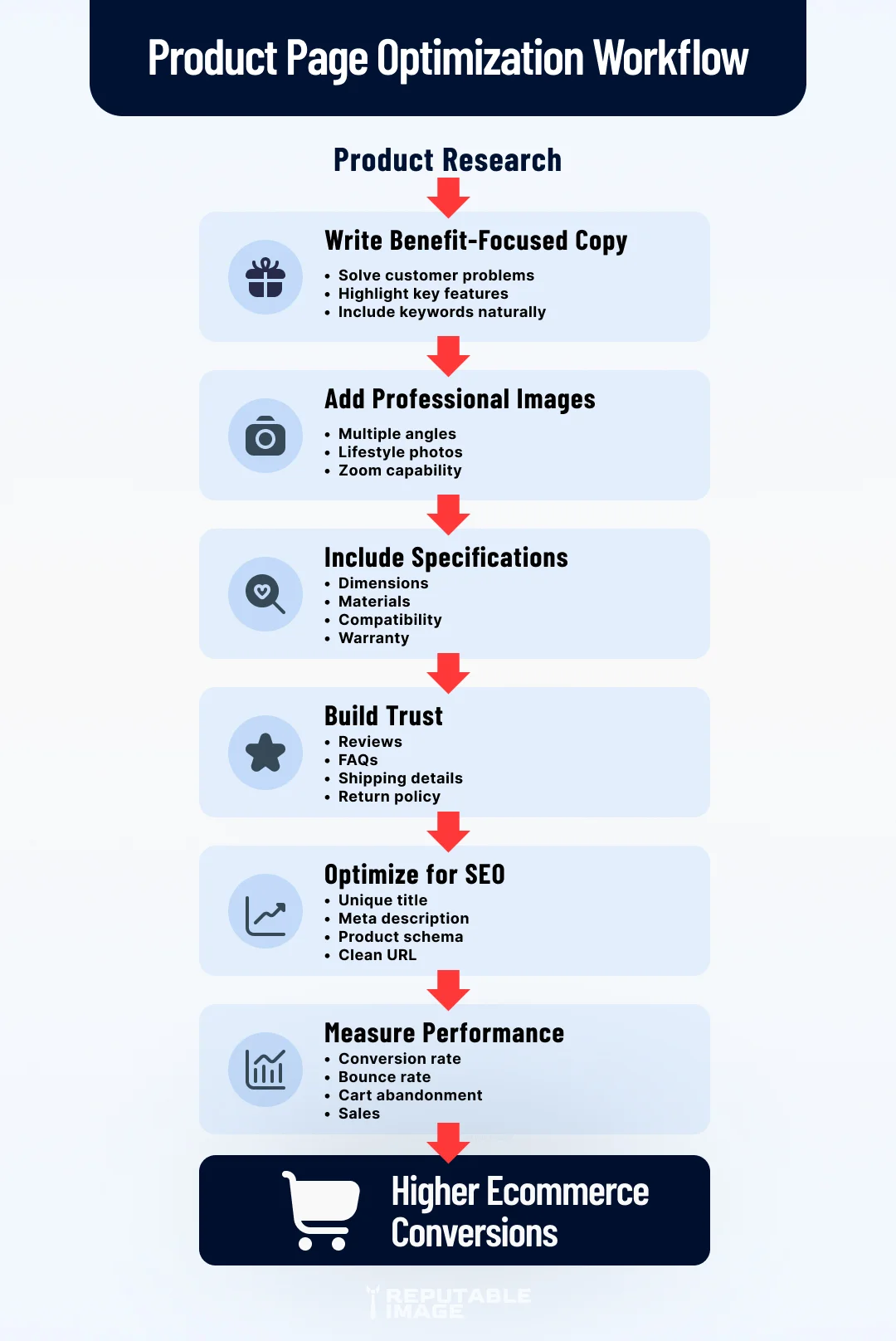
Content freshness matters too. Regularly update product pages with new photos, current pricing, and seasonal copy. If a product is temporarily out of stock, keep the page live with a clear notification and suggestions for alternatives—removing or redirecting the URL can waste the SEO equity you’ve built.
For stores with many products, prioritize optimization for best-sellers and high-margin items first. Even a handful of thoroughly optimized pages can deliver a substantial traffic and revenue lift.
Product page optimization isn’t a “set it and forget it” task. Consumer behavior, algorithm updates, and competitive landscapes evolve, and your pages should evolve with them. A data-driven approach to measurement uncovers what’s working and where friction still exists.
Key metrics to monitor include:
Approach optimization as a continuous cycle: hypothesize, test, measure, and refine. Over time, these incremental gains compound into a significantly more effective product page template that can be applied across your catalog.
Successful product pages are not merely digital shelves─they are dynamic sales tools that combine persuasive copy, professional photography, organized specifications, and robust trust signals into one seamless shopping experience. By thoughtfully designing each section and continually testing its impact, businesses can turn casual browsers into confident buyers while strengthening their search engine presence. In an e-commerce environment where every click counts, a well-optimized product page is one of the highest-ROI investments you can make.
At Reputable Image, we help businesses create high-performing e-commerce websites that blend compelling design with proven SEO strategies. If you're ready to improve your product pages and increase online sales, click below to Call for SEO help and get started.
Sources:
1. Google Search Central - "Introduction to Product structured data"
https://developers.google.com/search/docs/appearance/structured-data/product
2. Baymard - "1589 Product Page Design Examples"
https://baymard.com/ecommerce-design-examples/41-product-page
