
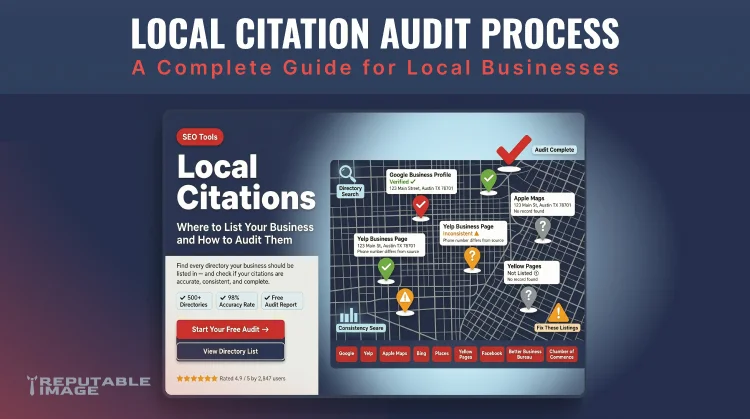
If you own a local business—whether it’s a coffee shop in Austin, a law firm in Chicago, or a plumbing service in Denver—your online presence hinges on one critical factor: trust. And in the world of local search, trust starts with consistency. That’s where local citations come in.
Local citations are online mentions of your business’s core information: your Name, Address, and Phone number (often abbreviated as NAP). These mentions can appear on major directory sites like Yelp, on industry-specific platforms like Avvo for lawyers, or even on neighborhood blogs and local news websites. Every time your business name is paired with your address or phone number in a digital space, that’s a citation.
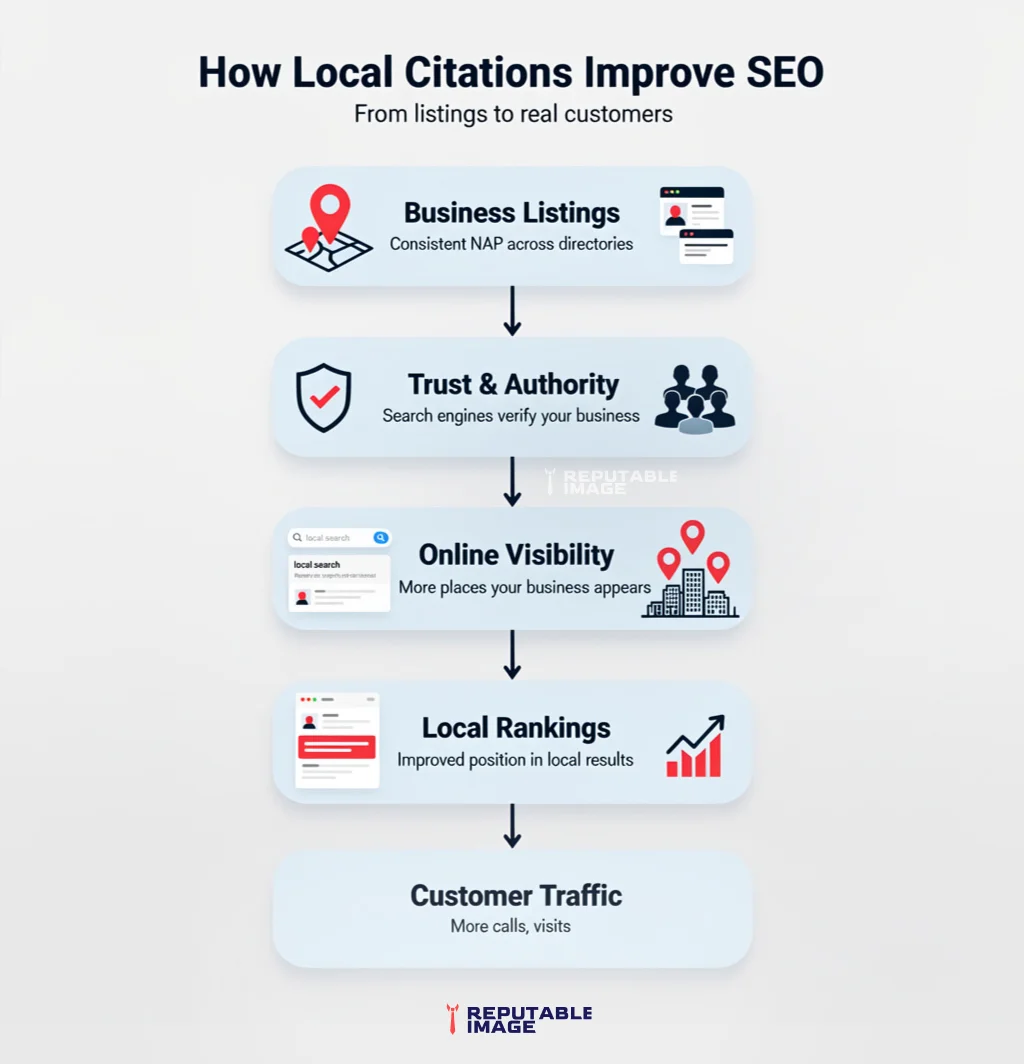
Search engines like Google use these citations as a form of digital verification. Think of them as social proof for your business’s location and legitimacy. When Google sees your NAP listed consistently across hundreds of authoritative websites, it gains confidence that your business is real, established, and relevant to local searchers.
However, the opposite is also true. Inconsistent or outdated citations—a misspelled street name, an old phone number, a listing that still shows your previous location—can confuse search engines and weaken your local SEO performance. This confusion often leads to lower rankings, lost trust, and frustrated customers who cannot find you.
Understanding where to list your business and how to audit your citations is not just a technical SEO task. It is a fundamental step toward improving your visibility, strengthening customer trust, and supporting long-term, sustainable growth.
It is tempting to view citations as a "set it and forget it" task. But the reality is that citations are a dynamic part of your local SEO foundation. Here is why they hold so much weight:
Search engines rely on citation data to confirm your business information across the web. According to Moz’s annual Local Search Ranking Factors survey, citation signals remain one of the top factors influencing local pack rankings. When your details are consistent across hundreds of platforms, it sends a strong signal of credibility.
Before a customer calls you or walks through your door, they often cross-check your information on multiple sites. They might find you on Google, then check your Yelp page, then look at your Facebook profile. If your address matches everywhere, they feel confident. If there is a discrepancy, they may choose a competitor instead.
Citations are directly linked to how your business appears on Google Maps. A strong, consistent citation profile helps Google associate your business with its geographic location. This improves your chances of appearing in the "Local Map Pack"—the box of three businesses that appears at the top of many local searches.
Beyond just consistency, the quality of your citations matters. A citation on a highly authoritative local chamber of commerce website carries more weight than a citation on a spammy, low-quality directory. Over time, building citations on trusted, relevant platforms helps you establish yourself as a legitimate player in your local market.
The question isn't just where to list, but which platforms will deliver the most value for your specific business. A shotgun approach—creating listings everywhere without thought—can waste time and create future management headaches.
Unlike annual plans that become irrelevant quickly, a quarterly calendar aligns perfectly with real business cycles and marketing goals. Planning in shorter 90-day sprints also makes it dramatically easier to evaluate what’s actually working. You can review key metrics, refine your approach, and improve your strategy for the next cycle with real data.
Every local business must be listed on these core platforms:
These companies distribute your data to hundreds of smaller directories. Claiming and managing your listing here is a high-leverage move:
Generic directories are helpful, but industry-specific citations often carry higher relevance and authority. Examples include:
The goal is not simply to create as many listings as possible. Instead, focus on quality, consistency, and relevance. A well-researched list of 20 high-quality, industry-specific directories will outperform 100 low-quality, spammy listings every time.
Consistency is the single most important factor in citation management. Your business name, address, and phone number should appear exactly the same across every single platform. To strengthen your local visibility strategy, read Local SEO for Multi-Location Businesses
What does "exactly the same" mean?
Even small differences in formatting can create inconsistencies that erode search engine trust. To avoid this, create a master citation document (a simple spreadsheet works). In this document, write your exact NAP exactly as you want it to appear everywhere. Then, use that single source of truth every time you register on a new platform.
Pro Tip: Standardize your phone number using the local format (e.g., (555) 123-4567) and stick with it. Avoid using a toll-free number in your local citations unless it is the only number you use.
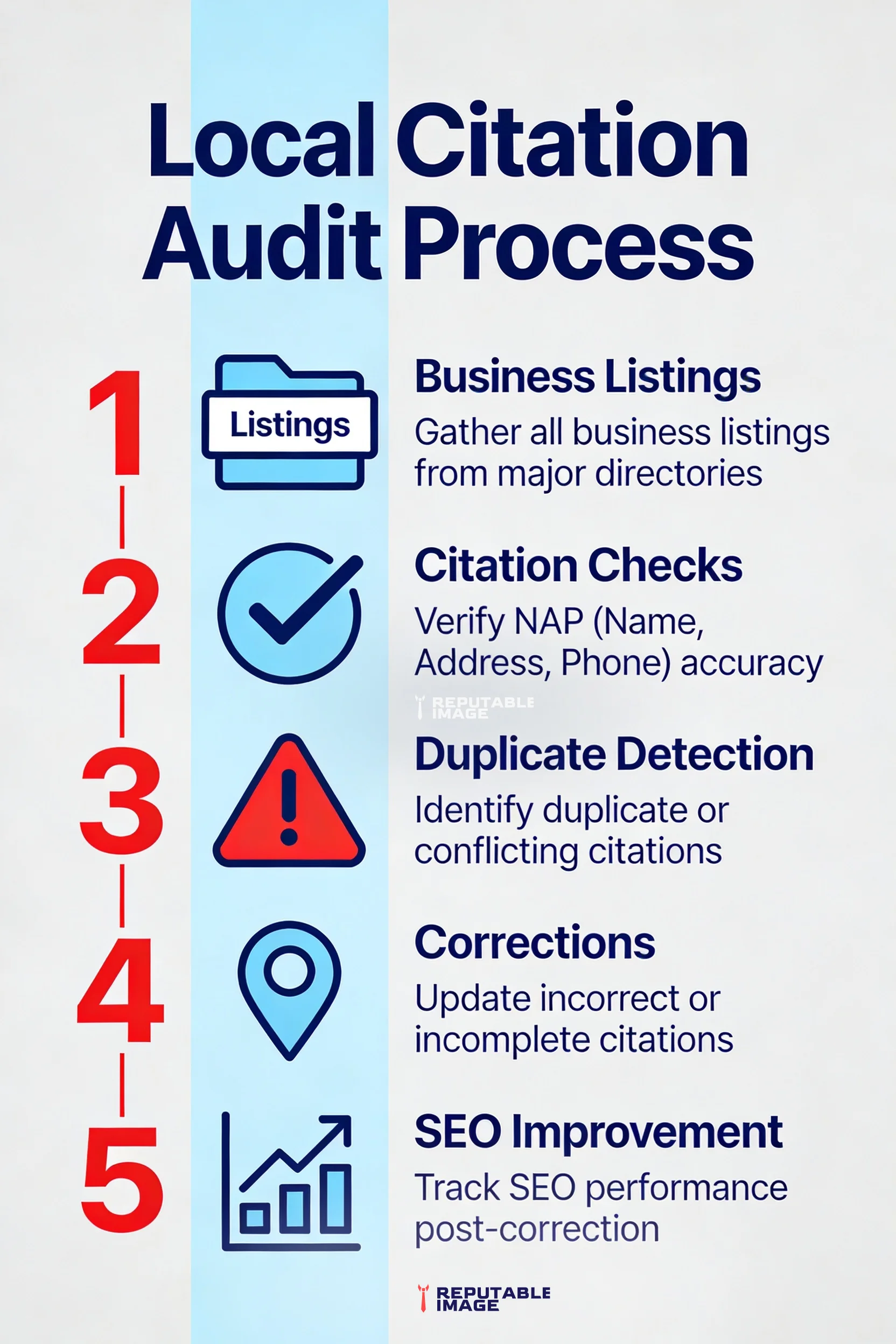
A citation audit is a health check for your local SEO. It helps you identify outdated, duplicate, or incorrect listings that may be dragging down your rankings.
Start by searching for your business name in Google. Take note of every listing that appears. Also, run a manual check on the "Big Four" platforms mentioned earlier.
For small businesses with fewer than 10 listings, a manual audit is manageable. Simply compare your master NAP document against each live listing. For businesses with dozens of citations, consider using a tool like:
During your audit, look for:
For each problem you find:
Even well-intentioned businesses create citation problems. Here are the most common pitfalls:
The solution is ongoing maintenance. Schedule a quarterly review of your top 20-30 citations. It takes 30 minutes but can save you months of ranking recovery later.
Local citations do not work in a vacuum. They are one piece of a larger puzzle that includes your website, online reviews, and Google Business Profile. To better understand structured business data, read Schema Structured Data
Think of citations as the foundation of a house. Your reviews are the walls (social proof), your GBP is the front door (the first point of contact), and your website is the roof (the final destination). If the foundation is cracked (inconsistent citations), the entire structure is unstable.
When you combine accurate citations with:
...you create a powerful, unified local presence. This alignment signals to the algorithm that your business is authoritative, trustworthy, and ready to serve local customers.
Managing local citations is not a one-time project. It is an essential, ongoing part of building a strong local SEO foundation. Accurate, consistent listings improve visibility, build trust with both search engines and customers, and directly support long-term search performance.
Businesses that actively maintain their citations—through regular audits, careful data management, and strategic expansion—are better positioned to compete and win in local markets.
But doing this effectively takes time, attention, and expertise. You need to know where to look, what to fix, and how to maintain consistency at scale.
At Reputable Image, we specialize in strengthening local SEO for businesses just like yours. We help you build a citation profile that is accurate, authoritative, and designed to drive real results.
Ready to improve your local presence and start generating more leads? Click below to Call and get started with a free consultation today.
